
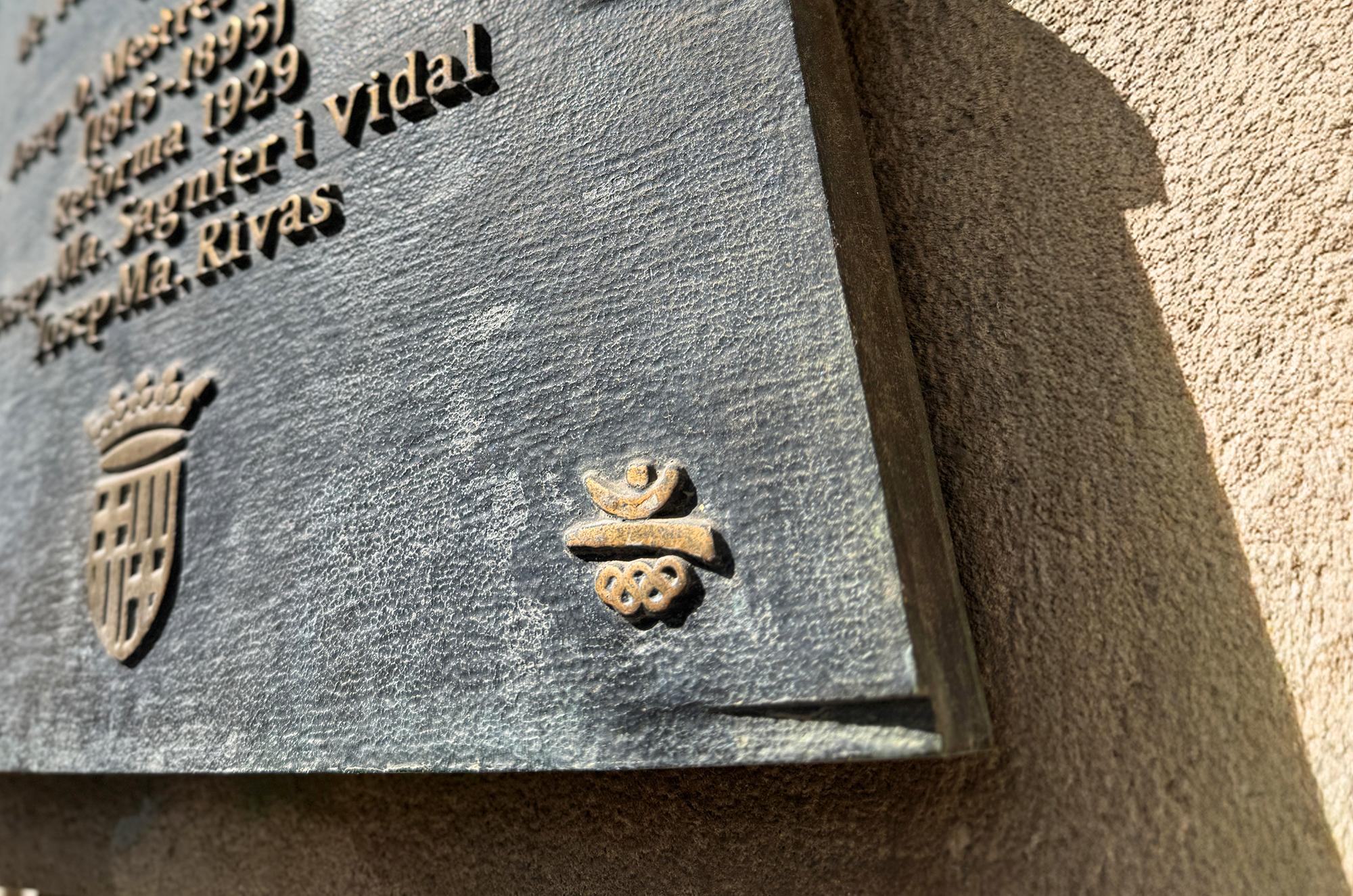
Rediscovering the Senyalització Històrica program of Barcelona ’92 Cultural Olympiad, which now shines gold.
On May 9, 1991, a plaque appeared on the façade of Casa Lleó Morera, the first of its kind. This house, an integral part of Barcelona’s famous “Block of Discord,” a masterpiece of Catalan Modernisme from the early 20th century, had lost part of its decoration after decades of neglect, yet what remains still amazes tourists. “Architect Lluís Domènech i Montaner,” the bronze letters of the plaque declare. Below, on the left, it reads Olimpíada Cultural, Barcelona’92, and in the right corner stands the logo of the Olympic Games 1992.
The scale of Barcelona’s Cultural Olympiad was unprecedented. “We will do more and better than anyone else, we will hold a four-year Cultural Olympiad” — this bold statement did not remain mere bravado to decorate the bid. The organizing committee threw itself into the work with enthusiasm, though it did not always have the resources it needed and could not avoid the problems that came with such ambition. Not all of the projects of the four-year plan were completed; some changed in duration and scope, while others overlapped.
The city’s architectural heritage was at the heart of several projects. The most famous was undoubtedly El Quadrat d’Or, focused on Modernista heritage, featuring a series of exhibitions, book presentations, guided tours through the “Golden Square” of the Eixample district, and light installations. The impact of El Quadrat d’Or is hard to overestimate — it was then that Barcelona rose to become one of the world’s leading tourist destinations. But the project that left a mark still visible in the city today, in the form of a series of bronze plaques on singular buildings, had a less flashy and more practical name: Senyalització Històrica.

Lluís Permanyer, 85, today one of Barcelona’s most respected chroniclers with more than 60 books about the city, was in the late 1980s a columnist at La Vanguardia, having shifted from international topics to the local chronicle. He recalls that Barcelona was then a very different city — one just beginning its transformation. When he proposed the installation of informational plaques, he pointed to London as an example. Maria Aurèlia Capmany, the city council’s Culture Councillor, liked the idea but lamented the lack of funds — at that time, not every house even had a street-name plate. She suggested he take the proposal to the Cultural Olympiad’s management, where Pep (Josep) Subirós, head of the program, gave his support.
The working group met in 1989. It was decided to divide the project into three thematic blocks — buildings, people, and events — with 150 plaques each, 450 in total. Lluís Permanyer would be responsible for events, journalist and historian Josep Maria Huertas for people, and Josep Maria Carandell, writer and art critic, for architectural heritage. The group agreed to start with Carandell’s section. The big name of industrial designer André Ricard left no room for competition: Subirós entrusted him, the creator of the Olympic torch, with designing the plaque. Permanyer believes this decision proved fatal for the project.

The square by the Antiga Masia de Can Trilla looks rather neglected. In its center stands a cast-iron fountain with four lanterns. Nothing else in the square is remarkable. Above the low doorway of Can Trilla hangs a crucifix, and to the right, the bronze plaque is covered with graffiti. Permanyer helps understand Josep Carandell’s logic in selecting buildings: while the aim of El Quadrat d’Or was to showcase Catalan Modernisme in all its splendor, Senyalització Històrica was about straightforward information, requiring that something significant be found in each neighborhood — if not artistically, then historically. This early 18th-century farmhouse, later used by a religious community, became such a site for Gràcia. Still, Permanyer reminds us, the project did not achieve its original goals.
The large bronze plaques, 40 × 42 cm, designed by André Ricard in collaboration with the graphic designer Yves Zimmermann, looked striking but were hard to read. Moreover, with their partially hand-crafted execution, they turned out far more expensive than expected. The price rose during the design process and, in its final form, reached 75,000 pesetas per plaque (about €1,200 in 2025). As the cost grew, the projected number of plaques shrank. The initial 450 were soon reduced to 180, then 150… In notes about the launch — the installation at Casa Lleó Morera — only 70 plaques were expected for the first phase. The project was cut short abruptly and prematurely.


Casa del Doctor Genové stands out even by Barcelona standards. Its emphatically vertical Modernista façade, with strong Neo-Gothic influences and blue-and-gold mosaics seems made for the pages of an alchemy book. On the entrance arch, to the right, one can still see some marks — a darkened square with four holes. Reconstructing the outcome of Senyalització Històrica is somehow following such traces: how many plaques were actually made, and where they were installed. Only accounting records bring some clarity — the eight documented orders of Vilagrasa, the manufacturer, confirm that between February and July 1991, sixty-one plaques were produced.
Not all of them were installed. Permanyer recalls the difficulties of obtaining permissions and the fact that not all buildings were suitable for such installations. What is more, as some of the landmarks — Palau del Baró de Quadras, Casa de les Punxes, Teatre del Liceu, etc. — were also chosen for the Bé d’Interès Cultural (BIC) initiative of Generalitat, the regional government, to highlight their legal protection, tensions emerged. In a later note, one of the project managers asked to postpone the installation at several buildings, despite permissions granted and plaques ready, as the buildings were subject to the BIC. These plaques were never installed.

New trouble came with later renovations. While the disappearance from Casa del Doctor Genové remains unclear, the plaque on Casa Francesc Piña on La Rambla was removed during 2009 alterations and never returned — a lamp now occupies its place. Bloc Diagonal, another of Carandell’s less obvious choices, takes us out of the city center. The building is currently under renovation, but the construction company has confirmed that the plaque has been preserved and will be put back.


Fifty* plaques produced for the first phase of the Senyalització Històrica project of the 1992 Cultural Olympiad can still be found on iconic buildings of Barcelona. Where façades are maintained, the dynamic human figure by Josep Maria Trias and the Olympic rings gleam golden — though they can only be discerned up close, lending weight to Permanyer’s criticism. Yet in one respect Ricard’s design fully meets the brief: it “ages well.” The slightly mannered design of the Senyalització Històrica plaques, and the need to know where to look, invite one to explore Barcelona through one of the most intriguing projects of the Cultural Olympiad — a route that has itself become part of the Olympic heritage.

***
The house at Cometa Street, 4, in the very heart of Barcelona’s Gothic Quarter, is remarkable for little — except that the Catalan composer Enric Morera was born here. A bronze plaque tells us so, the only plaque of the second phase of Senyalització Històrica identified so far.
* the Teatre Principal’s plaque is currently obscured by scaffolding due to ongoing renovations. The construction firm has been informed of the importance of protecting it.
Plaques92 App for iOS
With the Senyalització Històrica project, the Olympic Games highlighted dozens of singular buildings in Barcelona, offering us not only a story but also an experience. To facilitate exploration of the route, the mobile app Plaques92 was released for iOS devices (iPhones).
With the app, you can locate the buildings on the map, check whether the bronze plaque is still preserved, read concise introductions to the buildings, create routes, track your progress, and claim a reward upon completion.
Use the link or QR for the App Store. Every download supports this original research and helps preserve Barcelona’s Olympic legacy. Help us grow the project and make an Android version possible!


Results and Initiatives
The results of the research and the project materials are being shared with the Comité Olímpico Español (COE), the Museu Olímpic i de l’Esport Joan Antoni Samaranch, the Centre d’Estudis Olímpics (CEO-UAB), the Olympic Studies Centre (OSC) and the Ajuntament de Barcelona, accompanied by the following initiatives:
- Promote the preservation and proper maintenance of the existing plaques
- Assist in recovering or obtaining additional information about the project and its contributors
- Consider the restoration of the two lost plaques (Casa del Doctor Genové and Casa Francesc Piña) in the context of the upcoming 35th anniversary of the Barcelona ’92 Olympic Games.


The research has been accepted for publication by ISOH. Follow isoh.org for more discoveries.
All app materials are the result of original research and are published for the first time. Use is permitted only with proper author attribution. The research continues. For any questions or concerns: plaques92@gmail.com.
Research and project: Valerii Sazonov, iOS development: Egor Vdovin
The conversation with the late Lluís Permanyer was an honour, and the details he shared were invaluable for the project, which will now help preserve a unique part of his remarkable legacy.
Barcelona, Spain — 2025.